GCL Installation Guide: Lapping, Anchoring & Repair
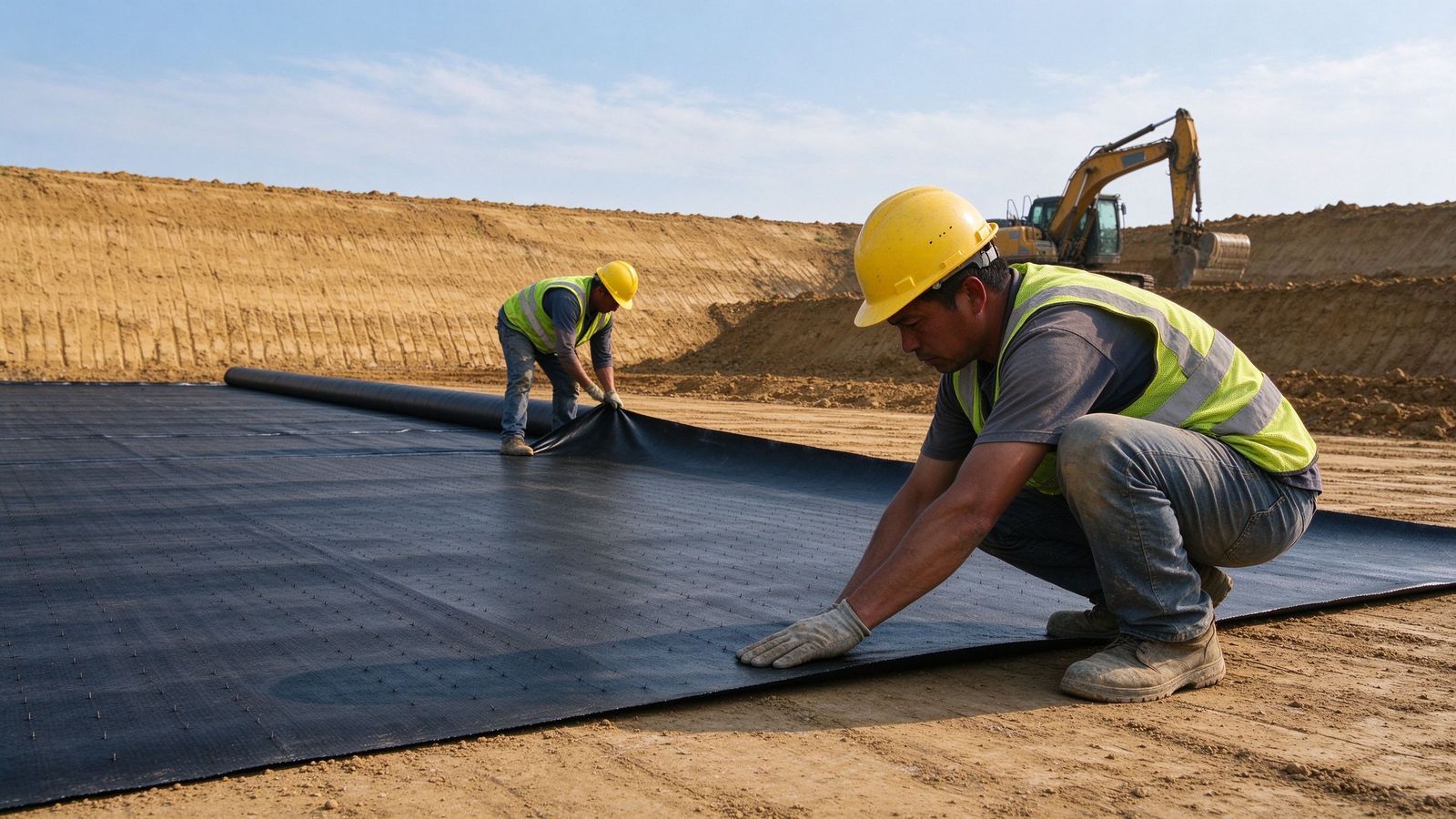
A geosynthetic clay liner (GCL) is a factory-made sandwich of sodium bentonite between two geotextiles. It self-seals when hydrated and is widely used alone or under HDPE geomembrane. The three things that decide its performance are: keeping it dry before covering, sealing every overlap, and anchoring it properly on slopes.
1Material at a Glance
| Property | Typical value |
|---|---|
| Na-bentonite mass | ≥ 4500 g/m² |
| Permeability (hydrated) | ≤ 5.0×10⁻¹¹ m/s |
| Swell index | ≥ 24 ml / 2 g |
| Width | 2–6 m |
| Standard | GB/T 21825 |
GCL replaces 300–600 mm of compacted clay with a 6–8 mm thick product — less excavation, faster placement, and it self-heals around minor punctures.
2Site Conditions — Protect It from Water
- Keep rolls dry: store off the ground under cover; cut open only what you can place the same day.
- No standing water on the subgrade when placing — hydrated bentonite cannot be reworked.
- Place the cover layer (soil or next geosynthetic) as soon as practical after each day's placement.
- In rainy seasons, schedule placement in 1–2 day windows with cover material standing by.
3Panel Placement & Lapping
- Unroll panels parallel to the slope on slopes; on flat floors, lay with the long edge in the direction you will cover next.
- Overlap 150–300 mm between panels — less than 150 mm risks seam leakage; more than 300 mm wastes material.
- Keep the overlap area clean; do not let soil or gravel sit between the two panels.
Fig. 1 Overlap sealing: 150–300 mm lap with granular bentonite applied, then covered by lap tape (schematic).
4Sealing the Overlaps
- Apply granular sodium bentonite ≈ 0.4 kg per linear metre along the overlap before closing the two panels.
- Fold the top panel over and secure with the factory lap tape, pressing firmly the full length.
- On slopes steeper than 1:3, add mechanical fastening (staples or pins) at 300–500 mm spacing along the overlap.
5Slope Anchoring
- Dig an anchor trench at the crest (500 mm wide × 500 mm deep minimum), lay the panel into it, backfill and compact — never leave the panel just lying over the crest.
- Leave 200–300 mm slack per 10 m of slope for shrinkage and subgrade settlement.
- If the slope exceeds 1:2, anchor the GCL at the crest before placing the HDPE layer above it, and check that the GCL has not slid during welding work.
6Repair & Composite Lining with HDPE
- Damaged areas: cut out the damaged panel section and patch with a new piece, overlapping 300 mm on all sides and sealing the perimeter with bentonite and lap tape.
- In a GCL + HDPE composite system, place HDPE directly above the GCL with a 100 mm+ overlap and weld as normal — the GCL provides the second line of defence.
- Log every repair with a photo and location for the QC record.
Practical tip: order GCL at the full site width (6 m panels) — every extra seam is an extra leak path and extra labour. Wider panels pay for themselves on large floor areas.
Need GCL for Your Project?
Tell us the area, slope profile and whether a cover layer is required — we reply within 24 hours with spec confirmation and a quote.
Email Us Request a Quote