Composite Drainage Geonet: Applications & Selection
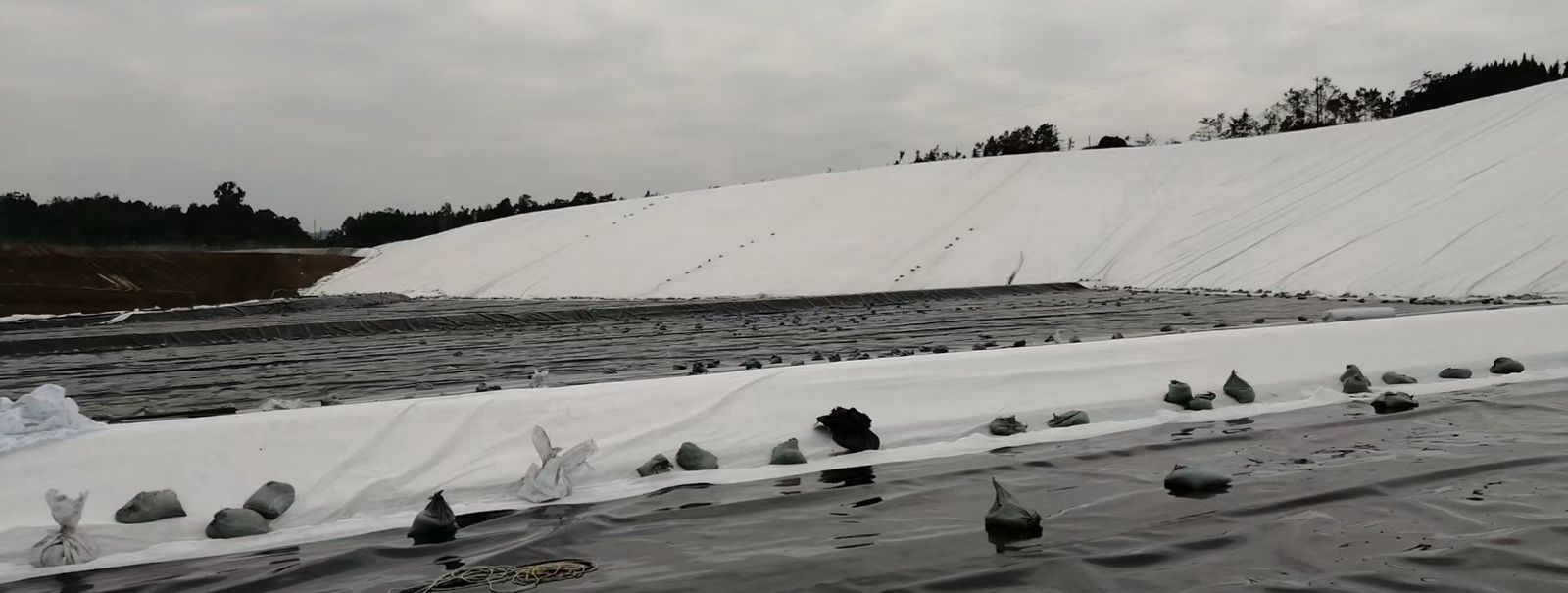
A composite drainage geonet — an HDPE cuspated net core with geotextile bonded on one or both sides — replaces thick gravel drainage layers with a thin, fast-installing sheet. This guide covers where it is used, how to select transmissivity, and the installation rules that keep it working.
1What a Composite Geonet Does
- The geonet core (5–8 mm, HDPE) creates a high-flow in-plane drainage channel; the geotextile filter lets water in while keeping soil out.
- One 8 mm geonet sheet can drain as much water as 300 mm of gravel — saving excavation depth, aggregate cost and installation time.
- Typical construction: geotextile / geonet / geotextile (double-sided) or geonet / geotextile (single-sided), per CJ/T 452.
2Key Applications
| Application | Function | Notes |
|---|---|---|
| Landfill leachate drainage | Drain leachate above the liner | Double-sided composite under protective soil |
| Landfill gas collection | Transmit gas to wells | High-transmissivity core, perforated pipes |
| Tunnel lining drainage | Drain groundwater behind the lining | Single-sided, geotextile against rock |
| Retaining wall / basement | Relieve hydrostatic pressure | Vertical panels, daylight at the base |
| Green roof & planter drainage | Drain water above the waterproofing | Lightweight, root-resistant core |
3Selecting Transmissivity
- The core spec is in-plane transmissivity (θ, m²/s) at the design normal load — not just core thickness.
- Calculate required flow = inflow area × design infiltration / drainage length; then pick θ with a safety factor of 2–3.
- Compression matters: transmissivity drops under load. Confirm the value at the actual overburden pressure (e.g. 100–500 kPa).
- Core crush strength (typically ≥ 300 kPa) must survive installation traffic and long-term load.
4Landfill Leachate Drainage
- Lay the composite above the geomembrane, geonet side down toward the liner or as designed, with geotextile filter on top.
- Connect to leachate collection pipes; ensure the geonet drains freely into the pipe slots (no geotextile wrap blocking inflow).
- Overlap panels and tape/seal joints with geotextile strips so soil can't intrude into the drainage plane.
- Protect from construction traffic until the cover soil is placed.
5Installation Rules
- Unroll upslope to downslope; the geonet drains in-plane, so every panel must discharge into a collection pipe or daylight.
- Never install with the drainage plane pinched, folded or blocked by a pipe flange.
- Overlaps 100–200 mm; on slopes, orient overlaps so upper panel lies over lower panel (shingle style).
- Anchor the top edge in a trench; intermediate anchors every 10–20 m on long slopes.
Fig. 1 Double-sided composite: geotextile / geonet core / geotextile (schematic).
6Cost-Saving Decisions
- Compare delivered cost of geonet vs gravel: geonet wins on haulage and excavation in remote sites, loses only on very short, low-flow drains.
- Choose single-sided where only one face needs filtration (e.g. against rock) — cheaper per m².
- Buy full-width rolls to reduce overlaps and joint taping on large landfill slopes.
Practical tip: if the drainage plane must pass over a pipe or protrusion, add a local gravel or protection layer — a folded geonet stops draining entirely at that point.
Designing a Drainage Layer?
Tell us the application, slope length and overburden pressure — we calculate the required transmissivity and quote FOB within 24 hours.
Email Us Request a Quote